9 posters · c. 300 BC to 1913
Mathematics
Founding texts of mathematics: Euclid’s Elements, Euler’s bridges of Königsberg, Pascal’s triangle, Fermat, Galois, Riemann, Cantor, Hilbert and Ramanujan.
-
Mathematics
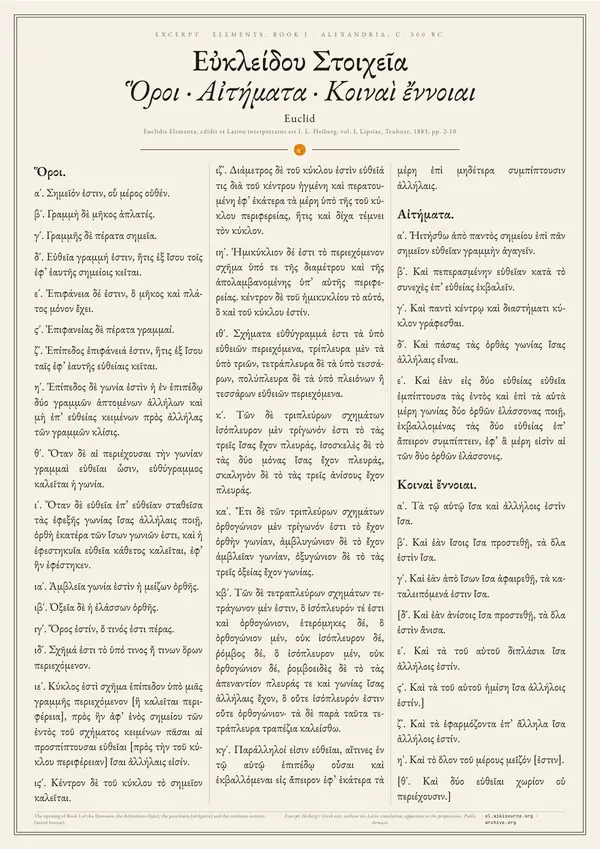
Euclid’s Elements, Book I: definitions, postulates and common notions
Euclid, c. 300 BC
The 23 definitions, five postulates and common notions that open Euclid’s Elements, in Heiberg’s Greek text.
Print from A3
-
Mathematics
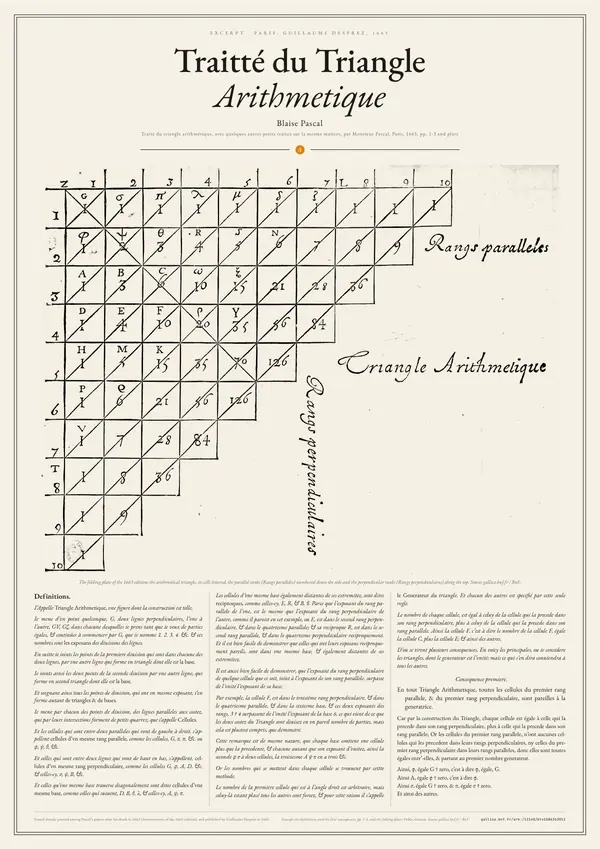
Traitté du Triangle Arithmetique
Blaise Pascal, 1665
Excerpt of Pascal’s treatise on the arithmetical triangle: its construction, the rule of its numbers and the first consequence.
Print from A3
-
Mathematics
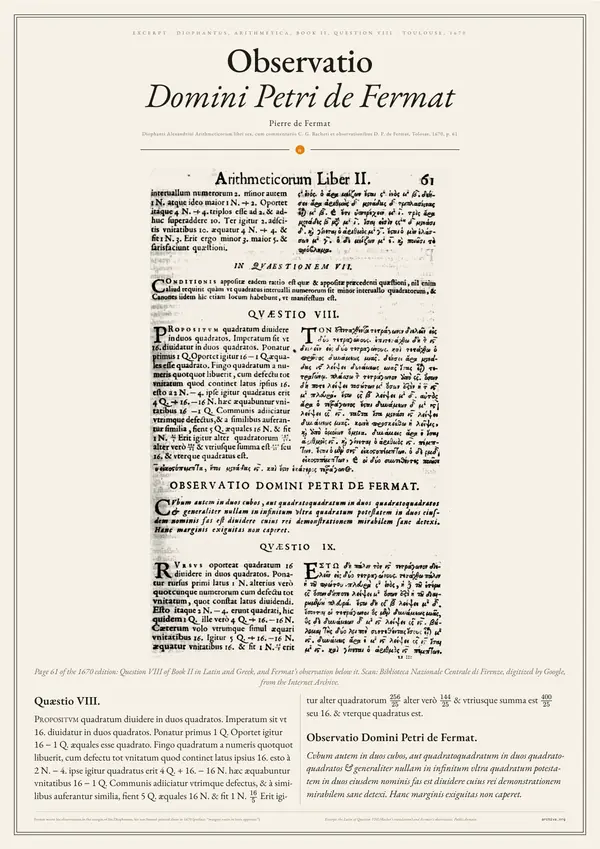
Observatio Domini Petri de Fermat
Pierre de Fermat, 1670
Fermat’s note that no cube or higher power splits into two like powers, with the question of Diophantus it annotates.
Print from A3
-
Mathematics
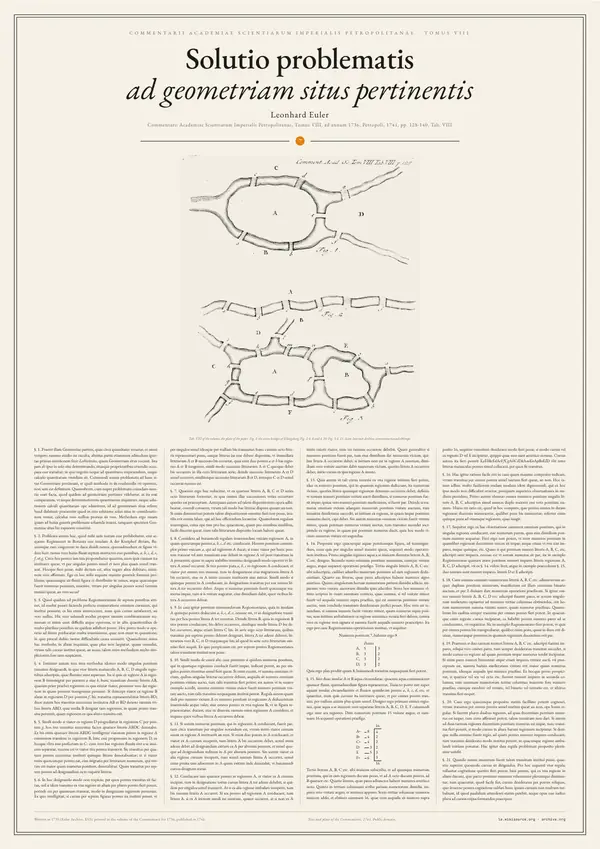
Solutio problematis ad geometriam situs pertinentis
Leonhard Euler, 1736
Euler shows that no walk crosses each of the seven bridges of Königsberg exactly once, and gives the general rule.
Print from A2
-
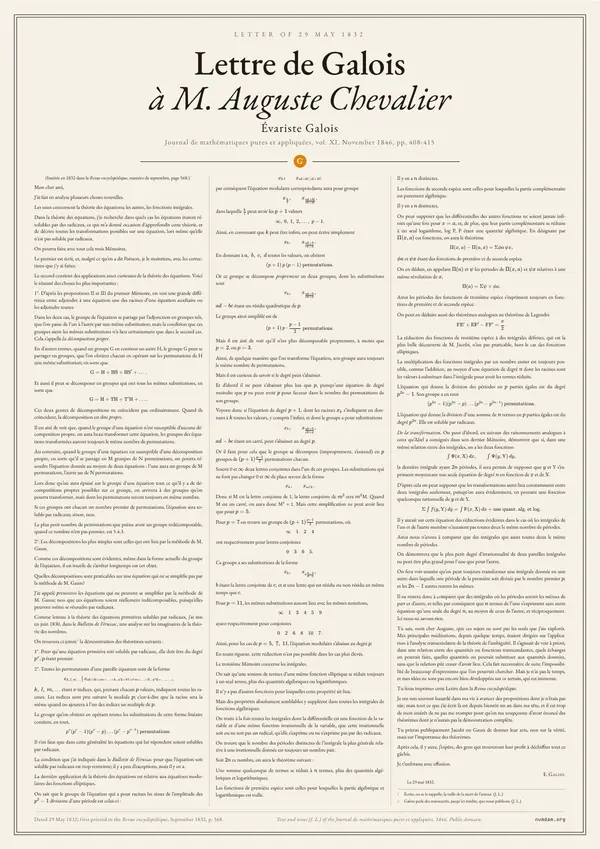
Mathematics
Lettre de Galois à M. Auguste Chevalier
Évariste Galois, 1832
Dated 29 May 1832, two days before his death, Galois’s letter summarizes his work on equations, groups and algebraic integrals.
Print from A2
-
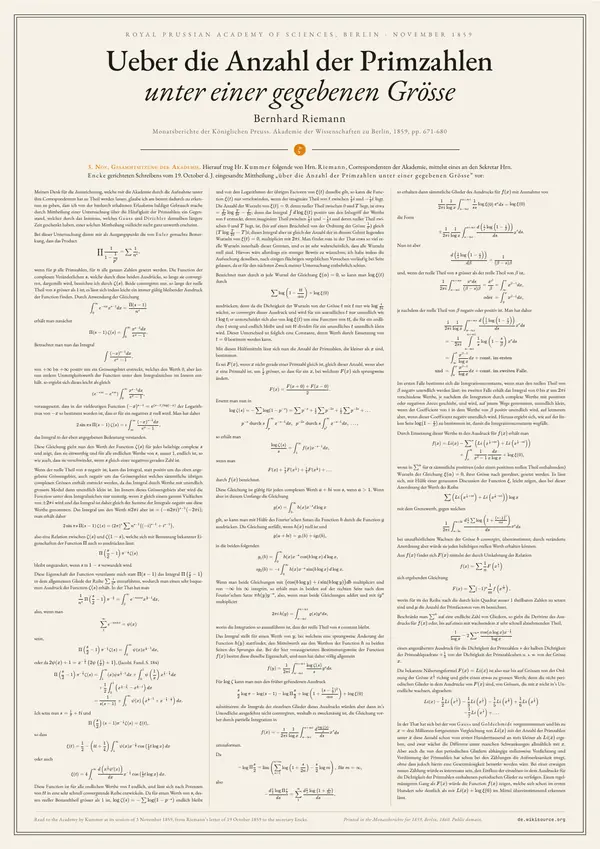
Mathematics
Ueber die Anzahl der Primzahlen unter einer gegebenen Grösse
Bernhard Riemann, 1859
Extends the zeta function to complex values, relates its zeros to the count of primes and states the Riemann hypothesis.
Print from A2
-
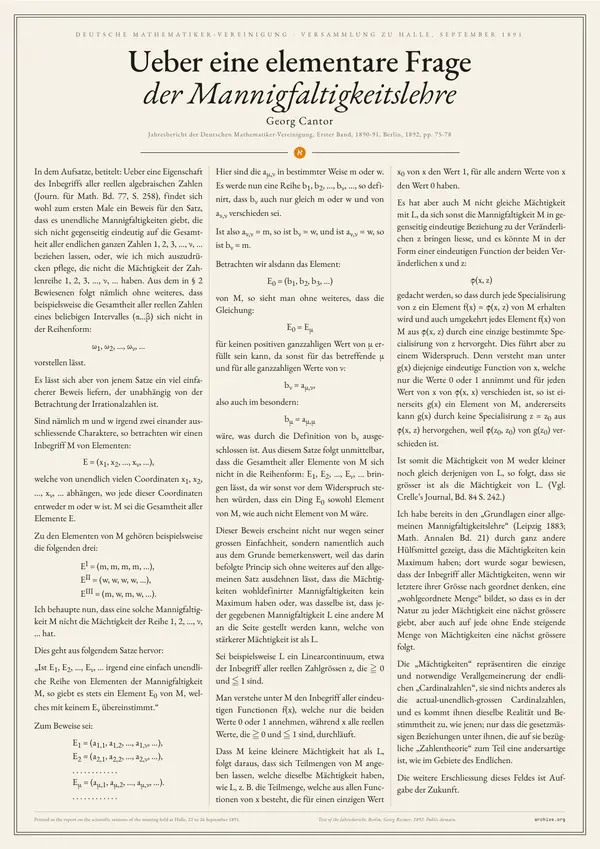
Mathematics
Ueber eine elementare Frage der Mannigfaltigkeitslehre
Georg Cantor, 1891
Cantor’s diagonal argument: the sequences of two symbols cannot be listed, and no set has the greatest cardinality.
Print from A3
-
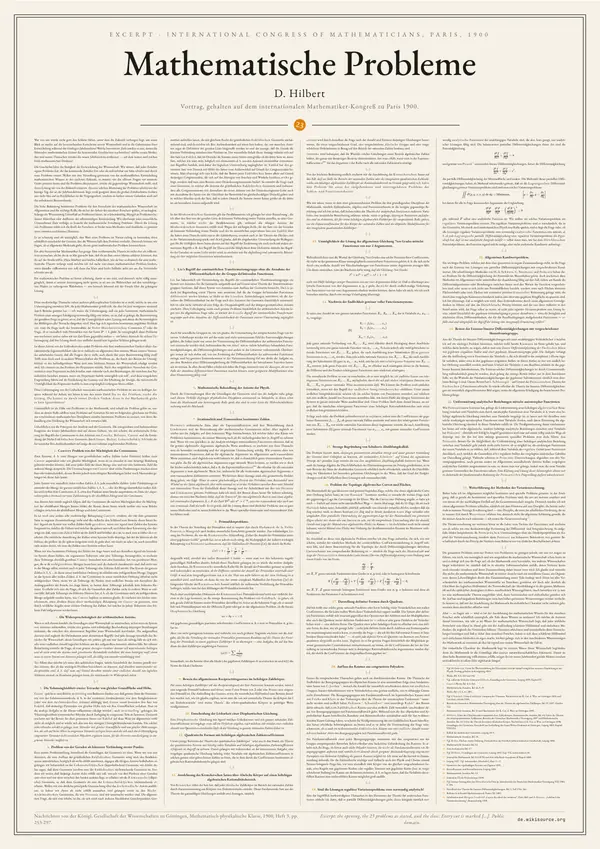
Mathematics
Mathematische Probleme
David Hilbert, 1900
Excerpt of the printed text of Hilbert’s 1900 Paris lecture, which sets out 23 problems for the new century.
Print from A1
-
Mathematics
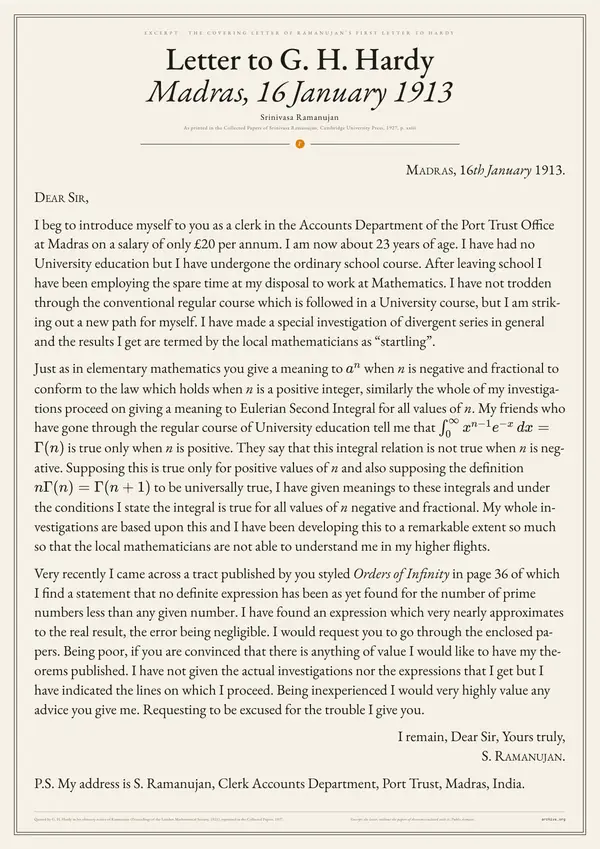
Letter to G. H. Hardy, 16 January 1913
Srinivasa Ramanujan, 1913
Ramanujan, a clerk in Madras, introduces himself to Hardy and sends him his theorems.
Print from A3


