12 posters · 1610 to 1929
Physics & astronomy
Landmark papers of physics and astronomy: Newton’s laws of motion, Galileo’s Moon, Einstein’s papers of 1905, Planck, Röntgen, Curie, Michelson and Morley, Hubble.
-
Physics & astronomy
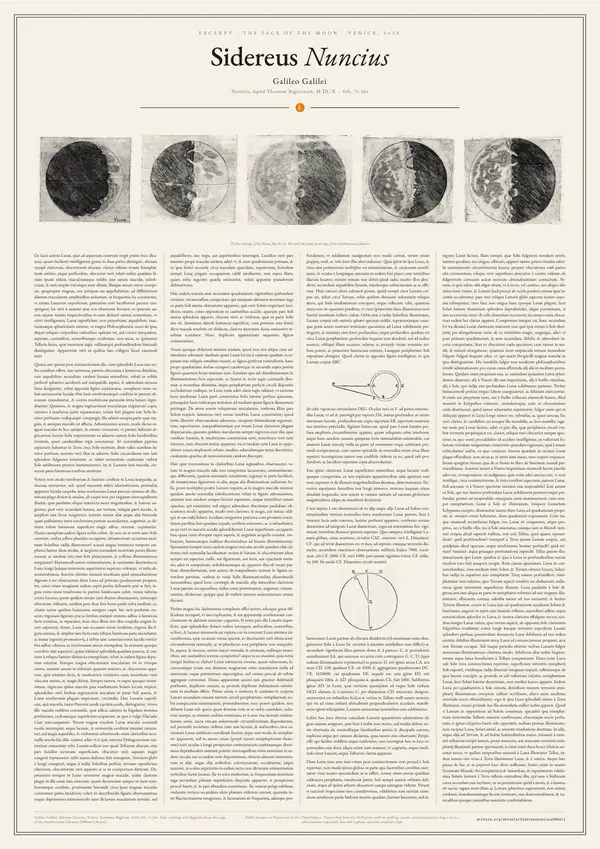
Sidereus Nuncius: the Moon
Galileo Galilei, 1610
Galileo’s telescopic observations of the Moon’s surface, mountains and earthshine, with his five etchings, from the 1610 edition.
Print from A2
-
Physics & astronomy
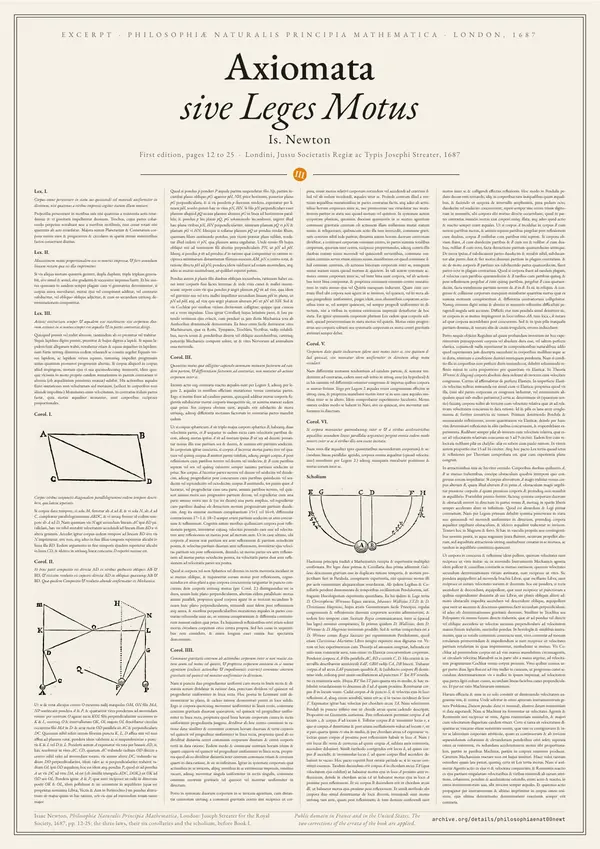
Axiomata, sive Leges Motus
Isaac Newton, 1687
Newton states the three laws of motion, derives six corollaries from them and reports pendulum collision experiments.
Print from A2
-
Physics & astronomy
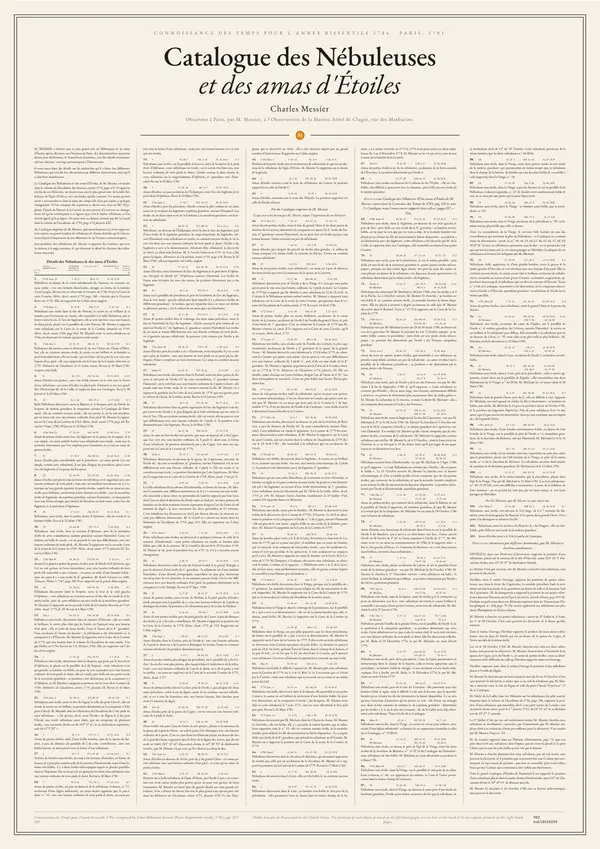
Catalogue des Nébuleuses et des amas d’Étoiles
Charles Messier, 1781
Charles Messier’s catalogue of 103 nebulae, star clusters and other objects observed from Paris, with positions and descriptions.
Print from A1
-
Physics & astronomy
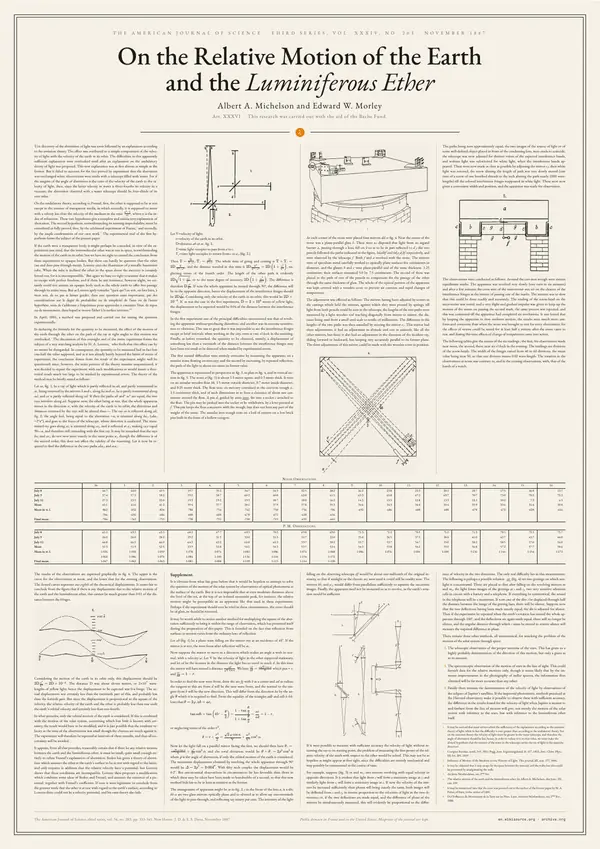
On the Relative Motion of the Earth and the Luminiferous Ether
Albert A. Michelson, Edward W. Morley, 1887
An interferometer turning on a stone floating on mercury detects no appreciable motion of the earth relative to the ether.
Print from A1
-
Physics & astronomy
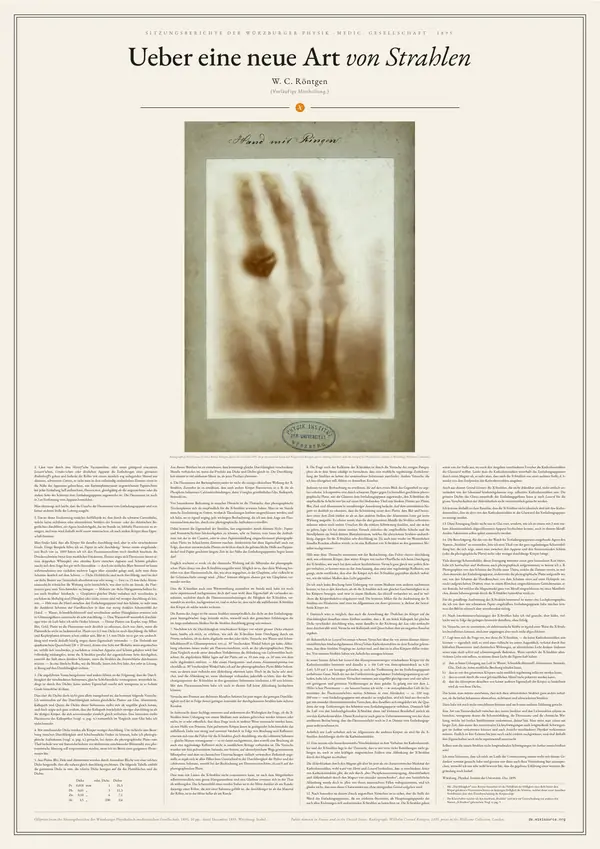
Ueber eine neue Art von Strahlen
Wilhelm Conrad Röntgen, 1895
Röntgen reports a new kind of rays that cross opaque bodies, blacken photographic plates and show the hand bones.
Print from A1
-
Physics & astronomy
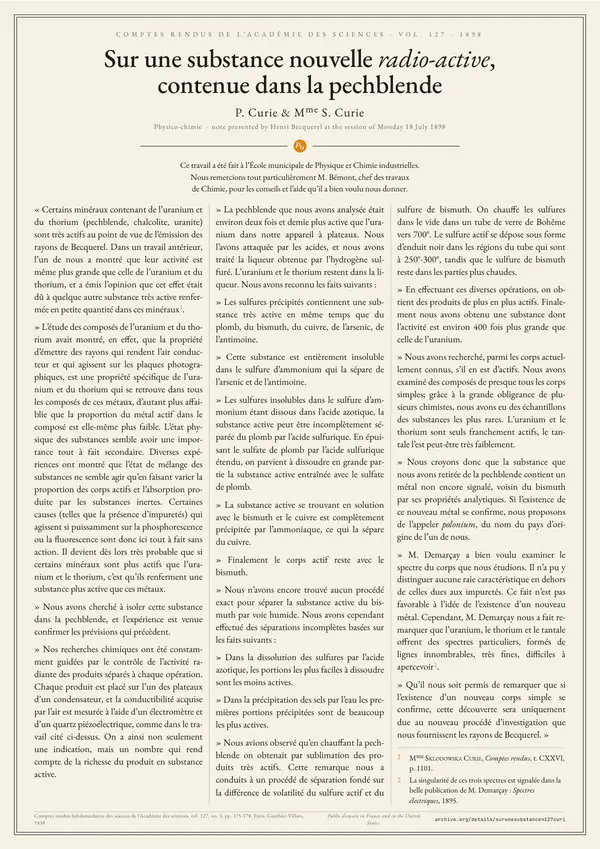
Sur une substance nouvelle radio-active, contenue dans la pechblende
Pierre Curie, Marie Curie, 1898
The Curies separate from pitchblende a substance far more active than uranium and name its presumed new metal polonium.
Print from A3
-
Physics & astronomy
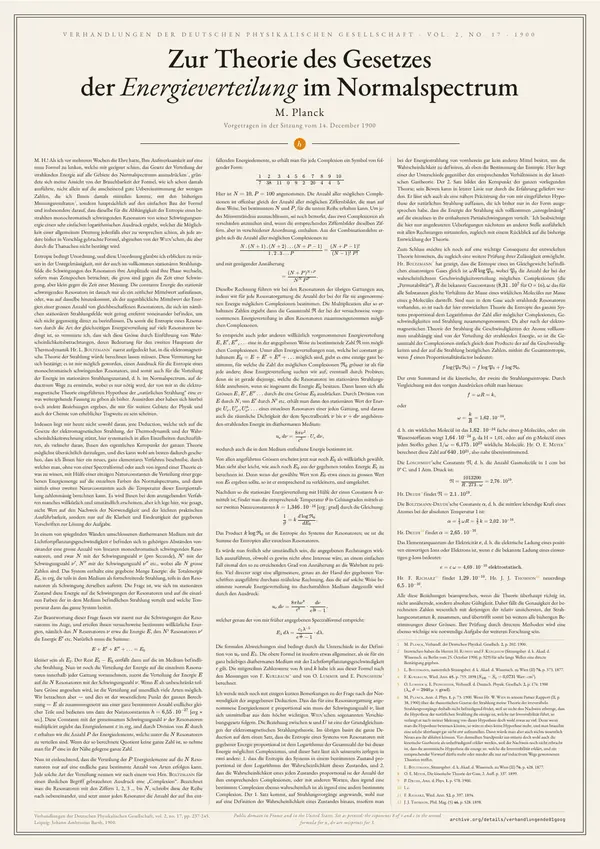
Zur Theorie des Gesetzes der Energieverteilung im Normalspectrum
Max Planck, 1900
Planck derives the spectral energy distribution by dividing resonator energy into finite elements hν and counting complexions.
Print from A2
-
Physics & astronomy
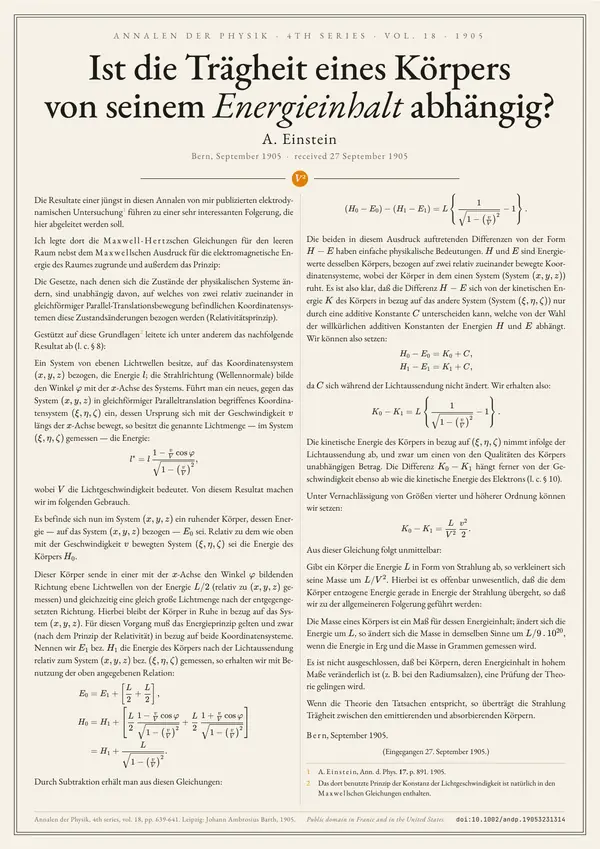
Ist die Trägheit eines Körpers von seinem Energieinhalt abhängig?
Albert Einstein, 1905
Shows that a body emitting energy L as radiation loses mass L/V², so its mass measures its energy content.
Print from A3
-
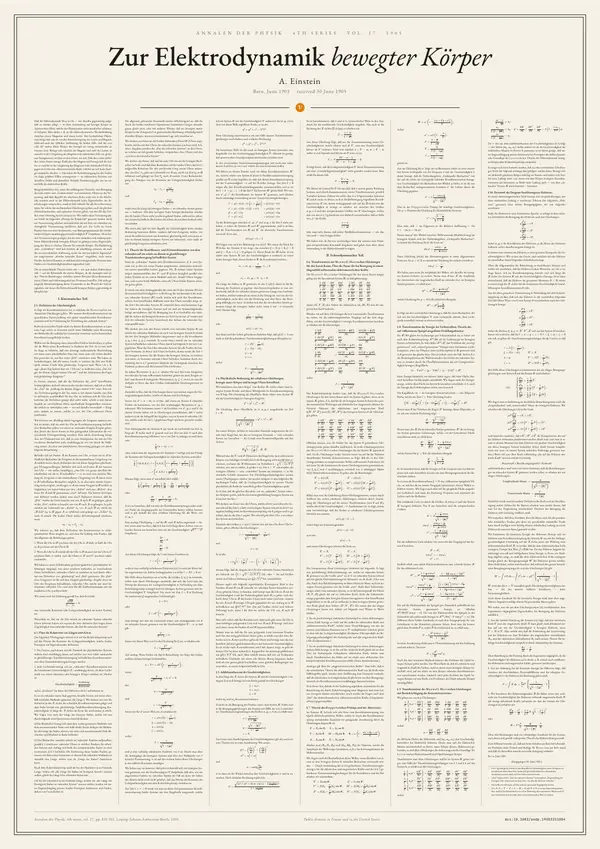
Physics & astronomy
Zur Elektrodynamik bewegter Körper
Albert Einstein, 1905
Derives special relativity from the relativity principle and the constant speed of light, and applies it to electrodynamics and optics.
Print from A0
-
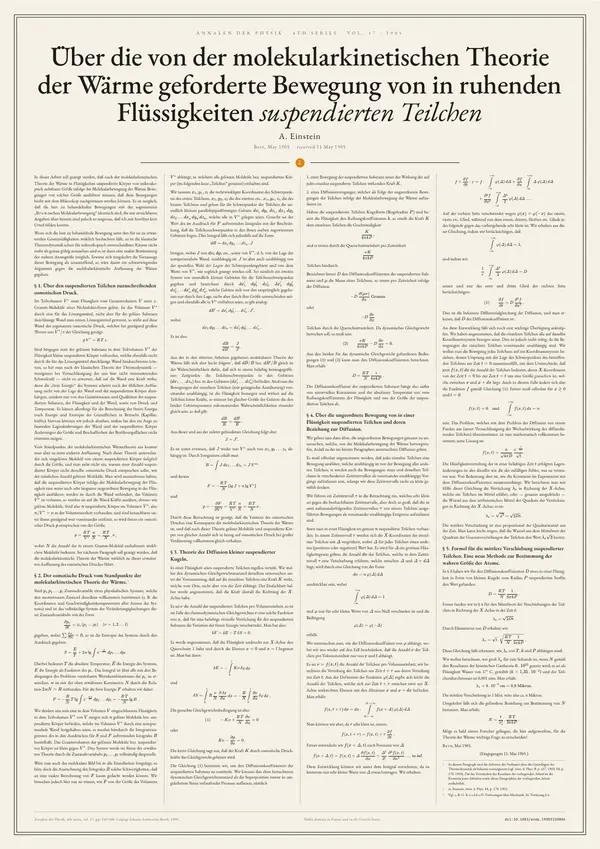
Physics & astronomy
Über die von der molekularkinetischen Theorie der Wärme geforderte Bewegung von in ruhenden Flüssigkeiten suspendierten Teilchen
Albert Einstein, 1905
Einstein derives the random motion of particles suspended in a liquid and relates their mean displacement to diffusion.
Print from A2
-
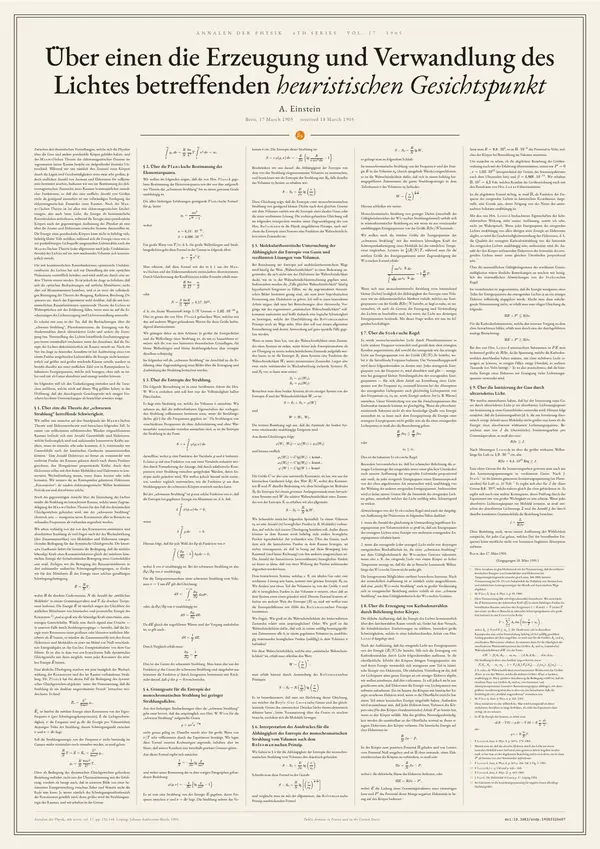
Physics & astronomy
Über einen die Erzeugung und Verwandlung des Lichtes betreffenden heuristischen Gesichtspunkt
Albert Einstein, 1905
Einstein proposes that light consists of energy quanta, and applies this to the Stokes rule, photoelectric effect and photoionization.
Print from A1
-
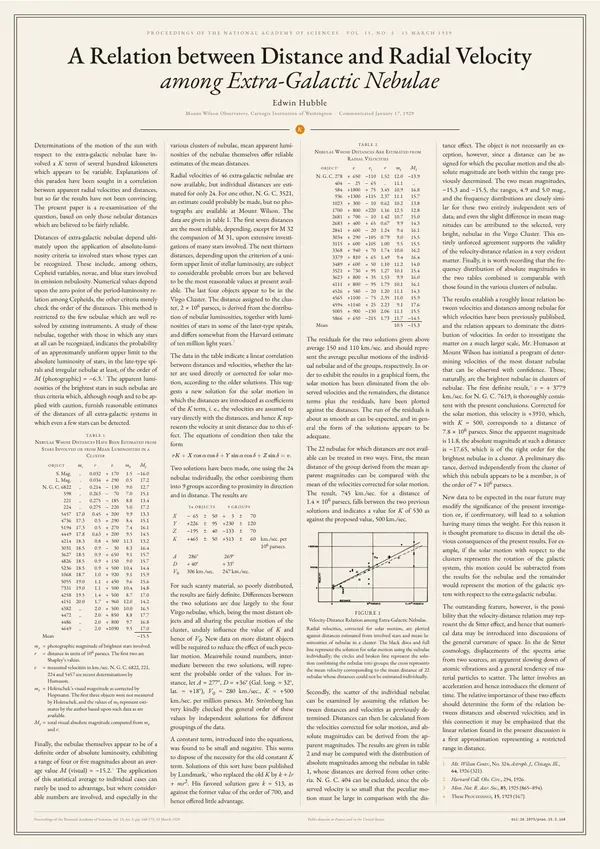
Physics & astronomy
A Relation between Distance and Radial Velocity among Extra-Galactic Nebulae
Edwin Hubble, 1929
Finds a roughly linear relation between the distances of extra-galactic nebulae and their radial velocities.
Print from A3


