Historical data visualization · 1686
Edmond Halley: An Historical Account of the Trade Winds, and Monsoons
Excerpt · Philosophical Transactions, no. 183 · 1686
- Source
- archive.org
- Retrieved
- 27 September 2026
- License
- Public domain
- Rights holder
- Edmond Halley, 1686
- Language
- English
About this edition and its rights
Edition
Text: “An Historical Account of the Trade Winds, and Monsoons, observable in the Seas between and near the Tropicks, with an attempt to assign the Phisical cause of the said Winds, by E. Halley”, Philosophical Transactions, vol. 16, no. 183 (1686), pp. 153-168 (doi:10.1098/rstl.1686.0026), in the scan of JSTOR’s Early Journal Content on the Internet Archive (philtrans09399630, which dates it 1753 by mistake). Excerpt: the first two paragraphs of p. 153, and the two paragraphs of pp. 162-163 that explain the map; the rest of the paper is left out. Transcribed from the OCR of the scan, corrected against the page images word by word (65 substitutions, most for the long s). The long s is set as s; the drop capital and small capital of “AN exact” are set as “An exact”; the space printed before semicolons and colons is dropped; words hyphenated at line ends are joined; the italics of the print are kept. “Monſ ons” on p. 163, where a letter is missing in the print, is read as Monsoons, as two lines below; “Æthiopick” on the same page, damaged in the print, is read as three lines above. Image: File:Edmond Halley’s map of the trade winds, 1686.jpg on Wikimedia Commons (3323 x 1103 px, grayscale, from Princeton University Library), with its levels stretched (60 to 185) to remove the show-through of the text printed on the back.
Rights
Edmond Halley died in 1742 and the paper and its map were published in 1686: they are in the public domain in France and in the United States.
The Internet Archive marks the scan with the Public Domain Mark (https://archive.org/details/philtrans09399630); Wikimedia Commons marks the image PD-old-70-1923 (https://commons.wikimedia.org/wiki/File:Edmond_Halley%27s_map_of_the_trade_winds,_1686.jpg).
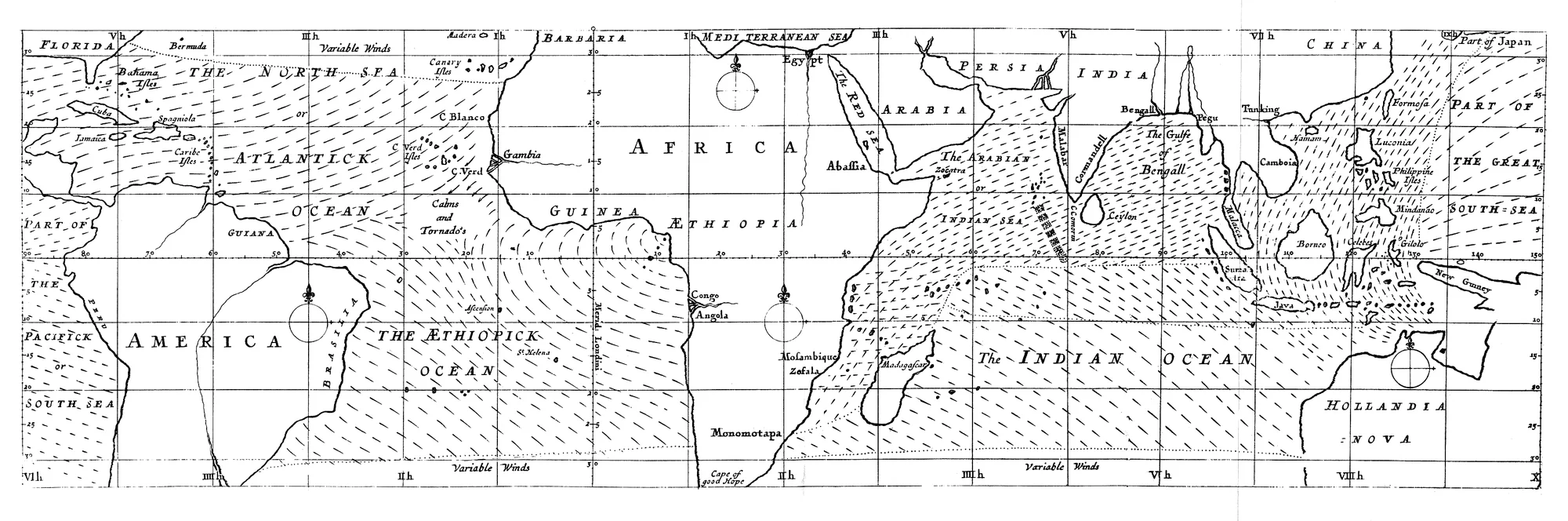
The opening of the paper#
Page 153.
An exact Relation of the constant and Periodical Winds, observable in several Tracts of the Ocean, is a part of Natural History not less desireable and useful, than it is difficult to obtain, and it’s Phænomena hard to explicate: I am not Ignorant that several Writers have undertaken this subject, and although Varenius (Lib. I. Chap. XXI. Geo. Gen) seems to have endeavoured after the best information from Voiagers, yet cannot his accounts be admitted for accurate, by those that shall attentively consider and compare them togather; and some of them are most evident mistakes; which, as near as I can, I shall attempt to rectify, having had the opportunity of conversing with Navigators acquainted with all parts of India, and having lived a considerable time between the Tropicks, and there made my own remarks.
The substance of what I have collected is briefly as follows.
On the map#
Pages 162-163.
To help the conception of the reader in a matter of so much difficulty, I believed it necessary to adjoyn a Scheme, shewing at one view all the various Tracts and Courses of these Winds; whereby ‘tis possible the thing may be better understood, than by any verbal description whatsoever.
The limits of these several Tracts, are designed every where by prickt lines, as well in the Atlantick and Æthiopick, where they are the boundaries of the Trade and Variable Winds, as in the Indian Ocean, where they also shew the extent of the several Monsoons. I could think of no better way to design the course of the Winds on the Mapp, than by drawing rows of stroaks in the same line that a Ship would move going alwaies before it; the sharp end of each little stroak pointing out that part of the Horizon, from whence the Wind continually comes; and where there are Monsoons the rows of the stroaks run alternately backwards and forwards, by which means they are thicker there than elsewhere. As to the great South Sea, considering its vast extent, and the little Variety there is in its Winds, and the great Analogy between them, and those of the Atlantick and Æthiopick Oceans, besides that the greatest part thereof is wholly unknown to us; I thought it unnecessary to lengthen the Mapp therewith.