Historical data visualization · 1874
Ernst Haeckel: Stammbaum des Menschen
Leipzig · 1874
- Source
- archive.org
- Retrieved
- 27 September 2026
- License
- Public domain (plate); notice: MIT
- Rights holder
- Ernst Haeckel, 1874
- Language
- German
About this edition and its rights
Edition
Ernst Haeckel, Anthropogenie oder Entwickelungsgeschichte des Menschen (Leipzig, Wilhelm Engelmann, 1874, first edition), in the scan of the Wellcome Library copy on the Internet Archive (b28059189): plate XII, “Stammbaum des Menschen”, bound between pages 496 and 497 (scan n540, 2620 x 4323 px), cropped to the plate with its title and imprints and with its paper tone scaled to white (one gain per channel); the foxing of the paper is left as it is. The names printed on the plate are transcribed from the scan, grouped under the four divisions marked on its right edge and listed from the root to the crown, an order chosen for the poster, and separated by middle dots; the brackets are set as parentheses, the full stop after “Gastraeaden” is kept, and “Jnfusionsthiere”, “Jnfusoria” and “Jnsecten” keep the J of the print. The plate’s title and “Taf. XII.” are in the header and the caption, not in the text. The entry of the plate in the list of plates (p. VI) is transcribed without its dotted leader. No transcription was found to compare with: the names were read on the scan word by word. The notice is not a period text: it was written for this poster from the title page, the list of plates, the plate and page 378 of this scan.
Rights
Ernst Haeckel died in 1919 and the book was published in 1874: it is in the public domain in France and in the United States. The Internet Archive marks the Wellcome Library scan with the Public Domain Mark.
The notice written for the poster is covered by the MIT license of this repository.
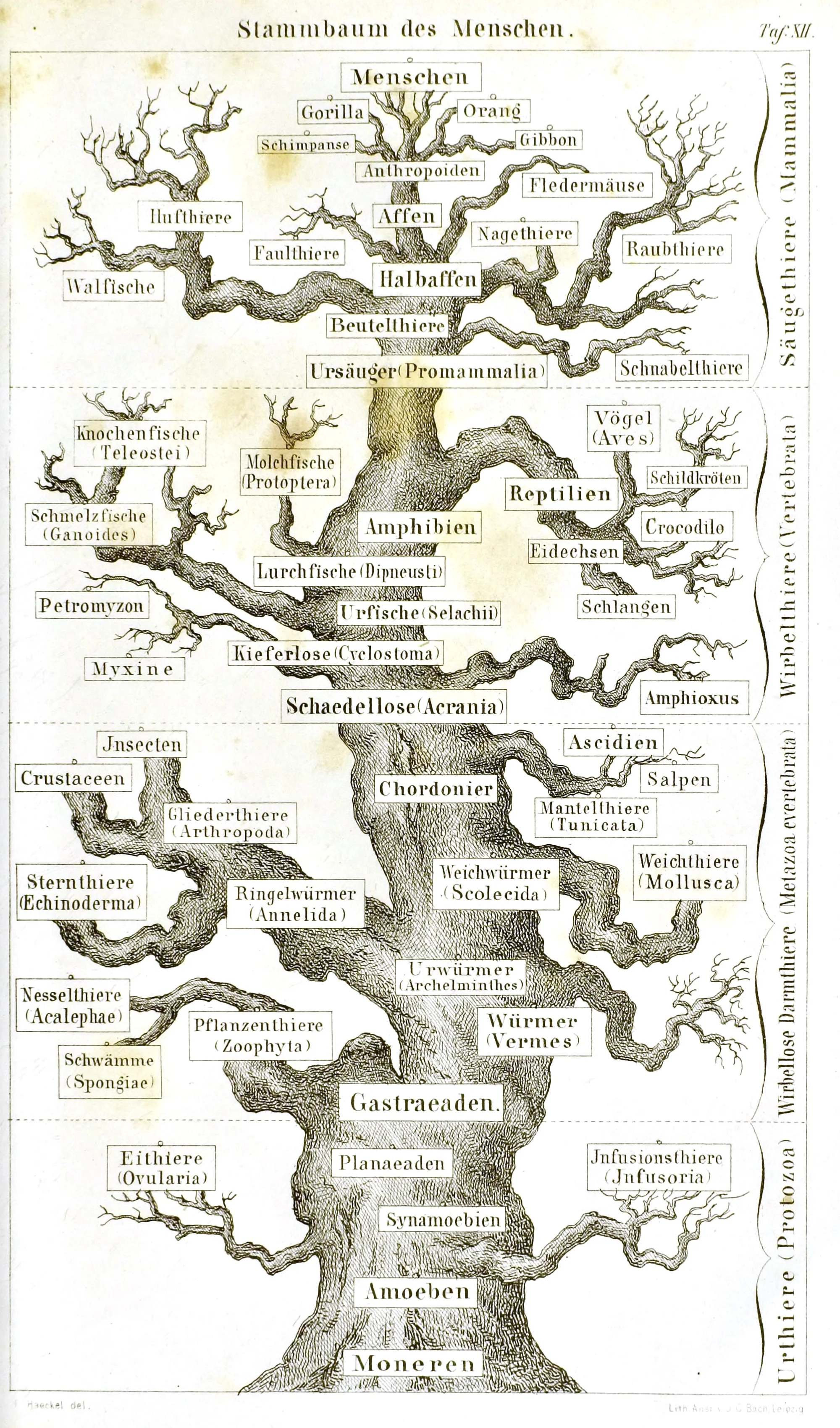
The names on the plate#
From the root to the crown, under the four divisions marked on its right edge.
Urthiere (Protozoa)#
Moneren · Amoeben · Synamoebien · Planaeaden · Eithiere (Ovularia) · Jnfusionsthiere (Jnfusoria)
Wirbellose Darmthiere (Metazoa evertebrata)#
Gastraeaden. · Schwämme (Spongiae) · Pflanzenthiere (Zoophyta) · Nesselthiere (Acalephae) · Würmer (Vermes) · Urwürmer (Archelminthes) · Weichwürmer (Scolecida) · Ringelwürmer (Annelida) · Sternthiere (Echinoderma) · Gliederthiere (Arthropoda) · Crustaceen · Jnsecten · Weichthiere (Mollusca) · Chordonier · Mantelthiere (Tunicata) · Salpen · Ascidien
Wirbelthiere (Vertebrata)#
Schaedellose (Acrania) · Amphioxus · Kieferlose (Cyclostoma) · Myxine · Petromyzon · Urfische (Selachii) · Schmelzfische (Ganoides) · Knochenfische (Teleostei) · Lurchfische (Dipneusti) · Molchfische (Protoptera) · Amphibien · Reptilien · Schlangen · Eidechsen · Crocodile · Schildkröten · Vögel (Aves)
Säugethiere (Mammalia)#
Ursäuger (Promammalia) · Schnabelthiere · Beutelthiere · Halbaffen · Walfische · Hufthiere · Faulthiere · Nagethiere · Raubthiere · Fledermäuse · Affen · Anthropoiden · Gibbon · Orang · Schimpanse · Gorilla · Menschen
Haeckel del. · Lith. Anst. v. J. G. Bach, Leipzig
In the list of plates#
Page VI of the book.
Tafel XII (zwischen S. 496 und 497). Stammbaum des Menschen. Erklärung 378
Notice#
A note written for this poster.
Ernst Haeckel, professor at the University of Jena, published the Anthropogenie oder Entwickelungsgeschichte des Menschen in Leipzig, with Wilhelm Engelmann, in 1874, with 12 plates, 210 woodcuts and 36 genetic tables. The twelfth plate, drawn by Haeckel and lithographed by J. G. Bach in Leipzig, is bound between pages 496 and 497.
It draws the descent of man as a single tree, from the Moneren at its root to the Menschen at its crown, with the other groups of animals on its side branches. For its explanation the list of plates refers to the eleventh table, on page 378: “Uebersicht über die wichtigsten Stufen in der thierischen Ahnen-Reihe des Menschen”.