Space exploration · 1977
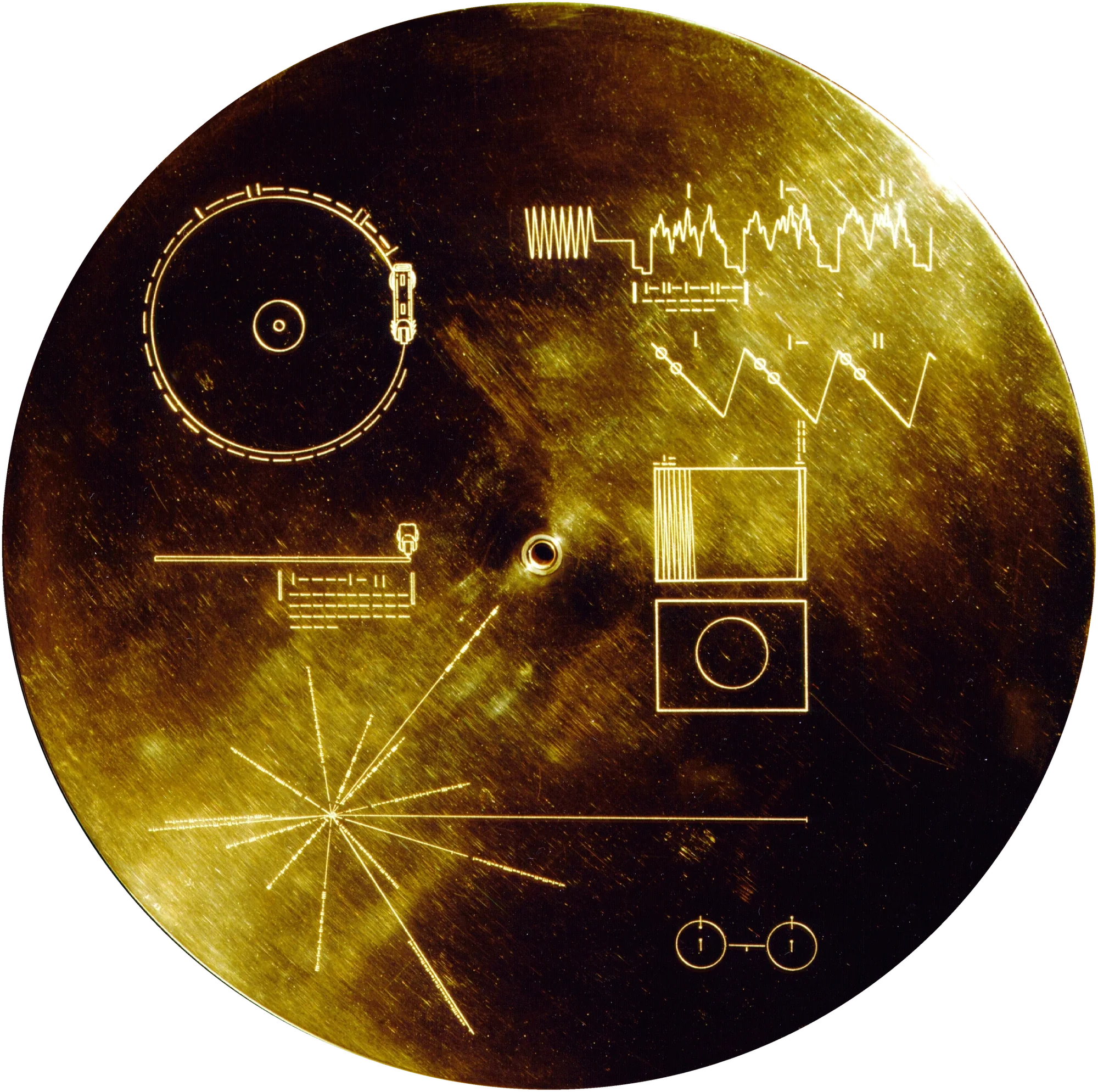
The Voyager Golden Record: the cover
The Sounds of Earth · Voyager 1 and Voyager 2 · 1977
- Source
- commons.wikimedia.org
- Retrieved
- 27 September 2026
- License
- Public domain (U.S. Government work); notice: MIT
- Rights holder
- NASA/JPL, 1977
- Language
- English

About this edition and its rights
Edition
Photograph GPN-2000-001978 of NASA’s Great Images in NASA collection (JPL number p24652b, dated 4 September 1977, “Creator/Photographer: NASA”, NASA Center: Jet Propulsion Laboratory; record read from its capture of 11 September 2011 by the Internet Archive, https://web.archive.org/web/20110911125940/http://grin.hq.nasa.gov/ABSTRACTS/GPN-2000-001978.html), as uploaded to Wikimedia Commons (2215 x 2215 px, SHA-256 89f8666e15f201cf4d428bc3e4d9bd11e064cedcac212a13f2124bc556055cff). For the poster the black background around the disc is made transparent: an ellipse fitted by eye to the rim of the disc (centre 1106, 1110; radii 1071 and 1065 px) keeps the disc, antialiased, and the image is cropped to it (2151 x 2139 px) and saved as WebP at quality 90. The part of the flare at the upper right that lies outside the rim is dropped with the background. The colours are those of the photograph. The cover bears no words, only engraved diagrams and binary numbers, so the poster has no text to transcribe. The notice below the image is not a period text: it was written for this poster, and every fact in it comes from two NASA pages, “The Golden Record Cover” (https://science.nasa.gov/mission/voyager/golden-record-cover/) and “Golden Record Overview” (https://science.nasa.gov/mission/voyager/voyager-golden-record-overview/), both retrieved on 27 September 2026, and from the NASA description of GPN-2000-001978.
Rights
In the United States, a photograph and a design of NASA (17 U.S.C. 105): the Great Images in NASA record credits the photograph to NASA (“Creator/Photographer: NASA”, NASA Center: Jet Propulsion Laboratory), and the Wikimedia Commons file page marks it PD-USGov-NASA. In France, the rule of the shorter term (article L. 123-12 of the Code de la propriété intellectuelle, after article 7(8) of the Berne Convention): for a work whose country of origin is outside the European Union and whose author is not a national of a member state, the protection lasts as long as in the country of origin, which grants none.
NASA Images and Media Usage Guidelines (https://www.nasa.gov/nasa-brand-center/images-and-media/, read on 27 September 2026): “NASA content [...] generally are not subject to copyright in the United States.” and “NASA should be acknowledged as the source of the material.”; material of third parties is “marked identified as copyright protected with the name of the copyright holder”, and this image is not. JPL Image Use Policy (https://www.jpl.nasa.gov/jpl-image-use-policy/, read from its capture of 13 May 2026 by the Internet Archive): “Unless otherwise noted, images and video on JPL public web sites (public sites ending with a jpl.nasa.gov address) may be used for any purpose without prior permission”, with the credit line “Courtesy NASA/JPL-Caltech.”, which the footer gives. JPL is operated for NASA by the California Institute of Technology, so the design team was not only federal employees; NASA and JPL publish the image without any third-party notice. The notice written for the poster is covered by the MIT license of this repository.
Notice#
A note written for this poster, from the descriptions of the cover published by NASA and its Jet Propulsion Laboratory.
Voyager 1 and Voyager 2 each carry the same record: a 12-inch disc of gold-plated copper holding greetings, music and natural and man-made sounds from Earth, and signals from which a technological civilization could rebuild pictures. An aluminium cover, plated with gold, shields it from micrometeorites and tells whoever finds it how to play it. The diagrams are engraved on both faces of the cover, since those on the outer face will wear away in time.
Upper left: playing the record#
The record is drawn from above with its stylus, set where playing begins, at the outer edge: it is played from the outside in. The binary number around it gives the time of one turn of the record, 3.6 seconds, counted in units of 0.70 billionths of a second, a period tied to a fundamental transition of the hydrogen atom. Below it, the record and stylus seen edge on, with a binary number for the playing time of one side, about an hour.
Upper right: building the pictures#
The top drawing is the signal that opens a picture. A picture is traced from it as a series of vertical lines, as television traces horizontal ones. Lines 1, 2 and 3 are marked in binary, with the length of a line, about 8 milliseconds. Below, the lines are drawn upright, interlaced so that the picture comes out right; then a whole picture of 512 vertical lines; then a copy of the first picture on the record, so that the decoding can be checked. It holds a circle, which comes out round only when the width and height of the picture are in the right ratio.
Lower left: the pulsar map#
The map first flew on the plaques of Pioneer 10 and 11. It places the solar system among 14 pulsars, whose precise periods are given.
Lower right: the hydrogen atom#
Two circles show the hydrogen atom in its two lowest states, joined by a line and the digit 1: the time of the transition between them is the unit of time for the cover and for the decoded pictures.
The uranium clock#
A spot of very pure uranium 238, two centimetres across, with an activity of about 0.00026 microcurie, is electroplated onto the cover. Half of it decays in 4.51 billion years, so the proportion of its daughter elements to the uranium left would tell a finder how long ago the spot was laid down: a check on the time of launch, which the pulsar map also records.