Biology & medicine · 1798
An Inquiry into the Causes and Effects of the Variolæ Vaccinæ
Excerpt · Cases XVI and XVII · 1798
- Source
- en.wikisource.org
- Retrieved
- 27 September 2026
- License
- Public domain
- Rights holder
- Edward Jenner, 1798
- Language
- English
About this edition and its rights
Edition
Excerpt: Case XVI and Case XVII, complete, pp. 31-35 of Edward Jenner, An Inquiry into the Causes and Effects of the Variolæ Vaccinæ (London, printed for the author by Sampson Low, 1798), with Plate No. 1, which Case XVI annexes. Text of the English Wikisource, whose pages of this part are all validated (level 4), from File:An Inquiry into the Causes and Effects of the Variolæ Vaccinæ - 1798.djvu on Wikimedia Commons, the Internet Archive scan b24759247 of the copy of the London School of Hygiene & Tropical Medicine Library; checked word by word against the page images of that scan. As in the transcription, the long s is set as s, the ligature ct as c t, and the spaces before ; are not kept; words hyphenated at line ends are joined; running heads, page numbers, catchwords and signature marks are left out. The footnote marked with an asterisk is numbered and set after the text. The case headings keep their capitals, set in the heading style of the poster. The rest of the book (the other cases and Jenner’s discussion) is left out. Plate No. 1: File:An Inquiry Into the Causes and Effects of the Variolæ Vaccinæ (1798) - illustration - No. 1.png on Wikimedia Commons (3976 x 1636 px), the plate extracted from the same Internet Archive scan (its file page credits archive.org/details/b24759247), saved as JPEG for the poster; its number and the engraver’s line, which the file leaves out, are given in the caption as engraved.
Rights
Published in 1798, before 1931: public domain in the United States. Edward Jenner died in 1823, and the engraver of the plate, William Skelton, in 1848, both before 1956: public domain in France.
The Internet Archive item b24759247 states: “This work is available under the Creative Commons, Public Domain Mark”. Wikimedia Commons marks the scan (https://commons.wikimedia.org/wiki/File:An_Inquiry_into_the_Causes_and_Effects_of_the_Variol%C3%A6_Vaccin%C3%A6_-_1798.djvu) and the plate (https://commons.wikimedia.org/wiki/File:An_Inquiry_Into_the_Causes_and_Effects_of_the_Variol%C3%A6_Vaccin%C3%A6_(1798)_-_illustration_-_No._1.png) public domain. The footer of Wikisource reads: “Text is available under the Creative Commons Attribution-ShareAlike License; additional terms may apply.” A word-for-word transcription of a public domain text adds no protected work.
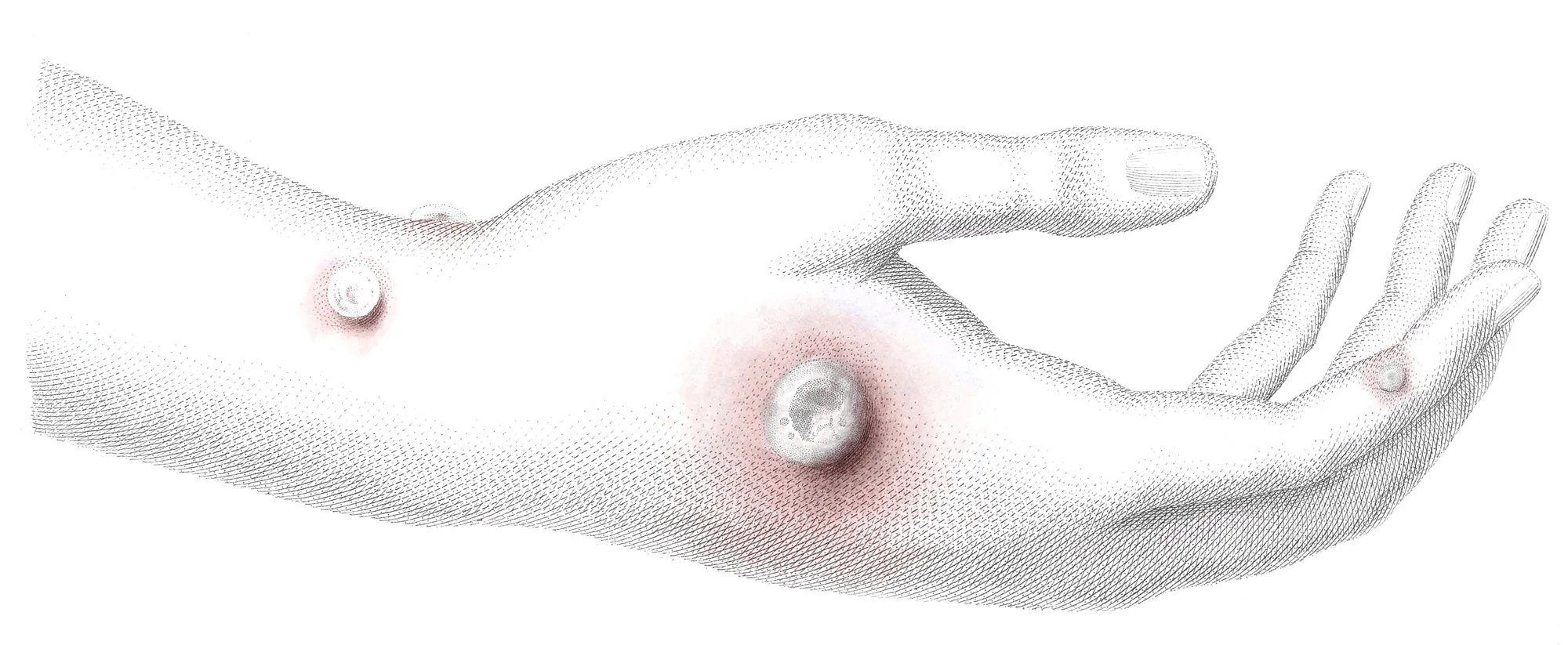
CASE XVI.#
SARAH NELMES, a dairymaid at a Farmer’s near this place, was infected with the Cow Pox from her master’s cows in May, 1796. She received the infection on a part of the hand which had been previously in a slight degree injured by a scratch from a thorn. A large pustulous sore and the usual symptoms accompanying the disease were produced in consequence. The pustule was so expressive of the true character of the Cow Pox, as it commonly appears upon the hand, that I have given a representation of it in the annexed plate. The two small pustules on the wrists arose also from the application of the virus to some minute abrasions of the cuticle, but the livid tint, if they ever had any, was not conspicuous at the time I saw the patient. The pustule on the fore finger shews the disease in an earlier stage. It did not actually appear on the hand of this young woman, but was taken from that of another, and is annexed for the purpose of representing the malady after it has newly appeared.
CASE XVII.#
THE more accurately to observe the progress of the infection, I selected a healthy boy, about eight years old, for the purpose of inoculation for the Cow Pox. The matter was taken from a sore on the hand of a dairymaid1, who was infected by her master’s cows, and it was inserted, on the 14th of May, 1796, into the arm of the boy by means of two superficial incisions, barely penetrating the cutis, each about half an inch long.
On the seventh day he complained of uneasiness in the axilla, and on the ninth he became a little chilly, lost his appetite, and had a slight head-ach. During the whole of this day he was perceptibly indisposed, and spent the night with some degree of restlessness, but on the day following he was perfectly well.
The appearance of the incisions in their progress to a state of maturation were much the same as when produced in a similar manner by variolous matter. The only difference which I perceived was, in the state of the limpid fluid arising from the action of the virus, which assumed rather a darker hue, and in that of the efflorescence spreading round the incisions, which had more of an erysipelatous look than we commonly perceive when variolous matter has been made use of in the same manner; but the whole died away (leaving on the inoculated parts scabs and subsequent eschars) without giving me or my patient the least trouble.
In order to ascertain whether the boy, after feeling so slight an affection of the system from the Cow-pox virus, was secure from the contagion of the Small-pox, he was inoculated the 1st of July following with variolous matter, immediately taken from a pustule. Several slight punctures and incisions were made on both his arms, and the matter was carefully inserted, but no disease followed. The same appearances were observable on the arms as we commonly see when a patient has had variolous matter applied, after having either the Cow-pox or the Small-pox. Several months afterwards, he was again inoculated with variolous matter, but no sensible effect was produced on the constitution.
Here my researches were interrupted till the spring of the year 1798, when from the wetness of the early part of the season, many of the farmers’ horses in this neighbourhood were affected with sore heels, in consequence of which the Cow-pox broke out among several of our dairies, which afforded me an opportunity of making further observations upon this curious disease.
A mare, the property of a person who keeps a dairy in a neighbouring parish, began to have sore heels the latter end of the month of February 1798, which were occasionally washed by the servant men of the farm, Thomas Virgoe, William Wherret, and William Haynes, who in consequence became affected with sores in their hands, followed by inflamed lymphatic glands in the arms and axillæ, shiverings succeeded by heat, lassitude and general pains in the limbs. A single paroxysm terminated the disease; for within twenty-four hours they were free from general indisposition, nothing remaining but the sores on their hands. Haynes and Virgoe, who had gone through the Small-pox from inoculation, described their feelings as very similar to those which affected them on sickening with that malady. Wherret never had had the Small-pox. Haynes was daily employed as one of the milkers at the farm, and the disease began to shew itself among the cows about ten days after he first assisted in washing the mare’s heels. Their nipples became sore in the usual way, with blueish pustules; but as remedies were early applied they did not ulcerate to any extent.
- 1From the sore on the hand of Sarah Nelmes.—See the preceding case and the plate. ↑