Patents · 1880
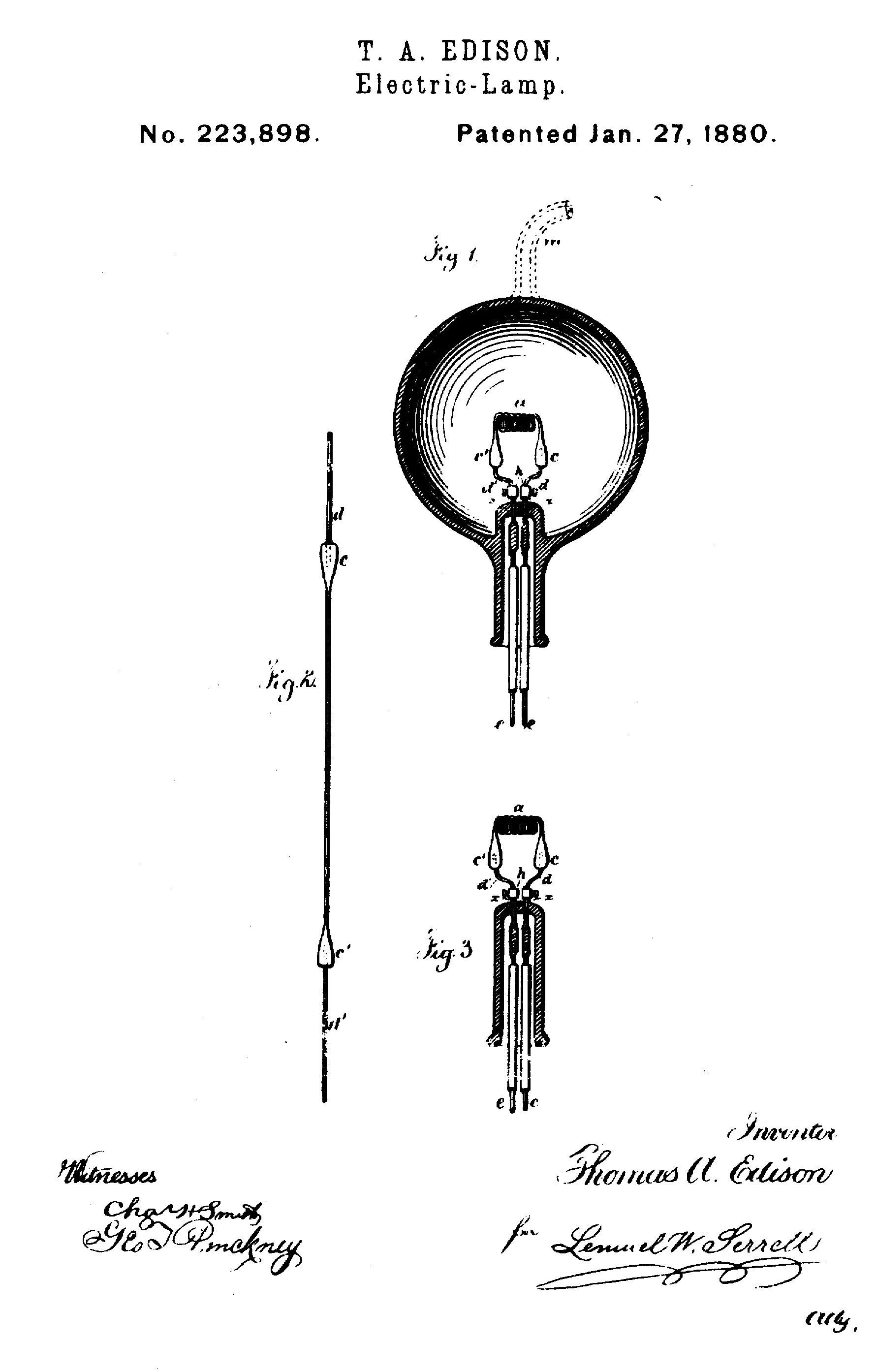
Thomas A. Edison: Electric-Lamp, US Patent 223,898
United States Patent Office · Letters Patent No. 223,898
- Source
- patents.google.com
- Retrieved
- 27 September 2026
- License
- Public domain
- Rights holder
- Thomas A. Edison, 1880
- Language
- English
About this edition and its rights
Edition
Scan of the printed patent linked from Google Patents (https://patentimages.storage.googleapis.com/d4/9b/62/aac68f7e65536c/US223898.pdf, 1-bit, 300 dpi; the PDF served by the USPTO, image-ppubs.uspto.gov, holds the same page images). Its first page, the sheet of drawings, is the image at the top, cropped to the drawing and its signatures and kept in black and white. The specification (pages 1 and 2) is transcribed in full, word for word from the scan: the Google Patents OCR and a second OCR made for this poster served as a base, and every line was checked against the page images. The printed heading (“UNITED STATES PATENT OFFICE.” / “THOMAS A. EDISON, OF MENLO PARK, NEW JERSEY” / “ELECTRIC LAMP.” / “SPECIFICATION forming part of Letters Patent No. 223,898, dated January 27, 1880.” / “Application filed November 4, 1879.”) is set in the header of the poster; the last line is almost illegible on the scan, and its date is the filing date given by Google Patents. Normalizations: words divided at line ends are rejoined without their hyphen, except in “nearly-perfect” and “air-washing”, divided at what reads as their own hyphen; page 2 repeats at its head the last two lines of page 1 (“material be molded around it in the act of carbonization there is an intimate union by com-”), given once here; the running heads and the line numbers of the margins are dropped; the prime of c′ and d′ is a prime sign. Small capitals are kept for the inventor’s name in the preamble and for the witnesses. The spelling of the print is kept (“platina”, “platinum”, “a inch”, “leading wires” without a hyphen in two places, “Signed by me this 1st day of November, A. D. 1879.”). The third page of the scan, a later certificate of the Commissioner of Patents limiting the term of the patent to that of its foreign counterparts and the order of 15 March 1893 cancelling it, is not reproduced. The caption of the drawing is not a period text: it was written for this poster from the specification.
Rights
US Patent 223,898 was granted to Thomas A. Edison on 27 January 1880 and printed by the United States Patent Office. In the United States, it was published before 1931, and patents are publications of the federal government. In France, its author died on 18 October 1931, before 1 January 1956 (Wikidata Q8743), so the term of protection has expired.
The USPTO states: “Subject to limited exceptions reflected in 37 CFR 1.71(d) & (e) and 1.84(s), the text and drawings of a patent are typically not subject to copyright restrictions.” (https://www.uspto.gov/terms-use-uspto-websites, section “Patent information”, retrieved 2026-09-27.)
To all whom it may concern:
Be it known that I, Thomas Alva Edison, of Menlo Park, in the State of New Jersey, United States of America, have invented an Improvement in Electric Lamps, and in the method of manufacturing the same, (Case No. 186,) of which the following is a specification.
The object of this invention is to produce electric lamps giving light by incandescence, which lamps shall have high resistance, so as to allow of the practical subdivision of the electric light.
The invention consists in a light-giving body of carbon wire or sheets coiled or arranged in such a manner as to offer great resistance to the passage of the electric current, and at the same time present but a slight surface from which radiation can take place.
The invention further consists in placing such burner of great resistance in a nearly-perfect vacuum, to prevent oxidation and injury to the conductor by the atmosphere. The current is conducted into the vacuum-bulb through platina wires sealed into the glass.
The invention further consists in the method of manufacturing carbon conductors of high resistance, so as to be suitable for giving light by incandescence, and in the manner of securing perfect contact between the metallic conductors or leading-wires and the carbon conductor.
Heretofore light by incandescence has been obtained from rods of carbon of one to four ohms resistance, placed in closed vessels, in which the atmospheric air has been replaced by gases that do not combine chemically with the carbon. The vessel holding the burner has been composed of glass cemented to a metallic base. The connection between the leading wires and the carbon has been obtained by clamping the carbon to the metal. The leading-wires have always been large, so that their resistance shall be many times less than the burner, and, in general, the attempts of previous persons have been to reduce the resistance of the carbon rod. The disadvantages of following this practice are, that a lamp having but one to four ohms resistance cannot be worked in great numbers in multiple arc without the employment of main conductors of enormous dimensions; that, owing to the low resistance of the lamp, the leading-wires must be of large dimensions and good conductors, and a glass globe cannot be kept tight at the place where the wires pass in and are cemented; hence the carbon is consumed, because there must be almost a perfect vacuum to render the carbon stable, especially when such carbon is small in mass and high in electrical resistance.
The use of a gas in the receiver at the atmospheric pressure, although not attacking the carbon, serves to destroy it in time by “air-washing,” or the attrition produced by the rapid passage of the air over the slightly-coherent highly-heated surface of the carbon. I have reversed this practice. I have discovered that even a cotton thread properly carbonized and placed in a sealed glass bulb exhausted to one-millionth of an atmosphere offers from one hundred to five hundred ohms resistance to the passage of the current, and that it is absolutely stable at very high temperatures; that if the thread be coiled as a spiral and carbonized, or if any fibrous vegetable substance which will leave a carbon residue after heating in a closed chamber be so coiled, as much as two thousand ohms resistance may be obtained without presenting a radiating-surface greater than three-sixteenths of an inch; that if such fbroua naterial be robbed witb s plaatic com- 8o| fbroua naterial be robbed witb s plaatic com- 8o posed of lamp-black and tar, its resistance may be made high or low, according to the amount of lamp-black placed upon it; that carbon filaments may be made by a combination of tar and lamp-black, the latter being previously ignited in a closed crucible for several hours and afterward moistened and kneaded until it assumes the consistency of thick putty. Small pieces of this material may be rolled out in the form of wire as small as seven one-thousandths of a inch in diameter and over a foot in length, and the same may be coated with a non-conducting non-carbonizing substance and wound on a bobbin, or as a spiral, and the tar carbonized in a closed chamber by subjecting it to high heat, the spiral after carbonization retaining its form.
All these forms are fragile and cannot be clamped to the leading wires with sufficient force to insure good contact and prevent heating. I have discovered that if platinum wires are used and the plastic lamp-black and tar material be molded around it in the act of carbonization there is an intimate union by combination and by pressure between the carbon and platina, and nearly perfect contact is obtained without the necessity of clamps; hence the burner and the leading-wires are connected to the carbon ready to be placed in the vacuum-bulb.
When fibrous material is used the plastic lamp-black and tar are used to secure it to the platina before carbonizing.
By using the carbon wire of such high resistance I am enabled to use fine platinum wires for leading-wires, as they will have a small resistance compared to the burner, and hence will not heat and crack the sealed vacuum-bulb. Platina can only be used, as its expansion is nearly the same as that of glass.
By using a considerable length of carbon wire and coiling it the exterior, which is only a small portion of its entire surface, will form the principal radiating-surface; hence I am able to raise the specific heat of the whole of the carbon, and thus prevent the rapid reception and disappearance of the light, which on a plain wire is prejudicial, as it shows the least unsteadiness of the current by the flickering of the light; but if the current is steady the defect does not show.
I have carbonized and used cotton and linen thread, wood splints, papers coiled in various ways, also lamp-black, plumbago, and carbon in various forms, mixed with tar and kneaded so that the same may be rolled out into wires of various lengths and diameters. Each wire. however, is to be uniform in size throughout.
If the carbon thread is liable to be distorted during carbonization it is to be coiled between a helix of copper wire. The ends of the carbon or filament are secured to the platina leading-wires by plastic carbonizable material, and the whole placed in the carbonizing-chamber. The copper, which has served to prevent distortion of the carbon thread, is afterward eaten away by nitric acid, and the spiral soaked in water, and then dried and placed on the glass holder, and a glass bulb blown over the whole, with a leading-tube for exhaustion by a mercury-pump. This tube, when a high vacuum has been reached, is hermetically sealed.
With substances which are not greatly distorted in carbonizing, they may be coated with a non-conducting non-carbonizable substance, which allows one coil or turn of the carbon to rest upon and be supported by the other.
In the drawings, Figure 1 shows the lamp sectionally. a is the carbon spiral or thread. c c′ are the thickened ends of the spiral, formed of the plastic compound of lamp-black and tar. d d′ are the platina wires. h h are the clamps, which serve to connect the platina wires, cemented in the carbon, with the leading-wires x x, sealed in the glass vacuum-bulb. e e are copper wires, connected just outside the bulb to the wires x x. m is the tube (shown by dotted lines) leading to the vacuum-pump, which, after exhaustion, is hermetically sealed and the surplus removed.
Fig. 2 represents the plastic material before being wound into a spiral.
Fig. 3 shows the spiral after carbonization, ready to have a bulb blown over it.
I claim as my invention—
1. An electric lamp for giving light by incandescence, consisting of a filament of carbon of high resistance, made as described, and secured to metallic wires, as set forth.
2. The combination of carbon filaments with a receiver made entirely of glass and conductors passing through the glass, and from which receiver the air is exhausted, for the purposes set forth.
3. A carbon filament or strip coiled and connected to electric conductors so that only a portion of the surface of such carbon conductors shall be exposed for radiating light, as set forth.
4. The method herein described of securing the platina contact-wires to the carbon filament and carbonizing of the whole in a closed chamber, substantially as set forth.
Signed by me this 1st day of November, A. D. 1879.
THOMAS A. EDISON.
Witnesses:
S. L. Griffin,
John F. Randolph.